Rethinking Higher Education: How ACEL Is Breaking Down Barriers to Learning
The Changing Face of Higher Education
Today’s student body is more diverse than ever before, and the model of a traditional student is an outdated one.
At IHCL, every student is unique.
We’re welcoming learners who wish to study in non-traditional ways, in non-traditional settings and those from widening participation backgrounds. Many are people returning to education after years in the workforce, care leavers building new futures, care providers seeking flexibility, and neurodivergent students who learn brilliantly but differently. Each brings unique strengths, challenges, and life experiences that traditional one-size-fits-all approaches simply can’t accommodate.
This isn’t just about being inclusive - it’s about recognising that diverse perspectives and experiences make education richer for everyone. When we design learning that works for a single parent studying at midnight or a dyslexic professional who processes information visually, we create better learning for all students.
When Traditional Learning Doesn t Fit
Picture this: You’re a working parent trying to juggle a full-time job, family responsibilities, and the dream of advancing your career through higher education. Traditional university schedules don’t accommodate your Tuesday evening parent-teacher conference or the fact that you think most clearly at 6 AM before the house wakes up. Sound familiar?
Learning and teaching environments have fundamentally changed, yet much of higher education remains stuck in outdated models. In our modern world, education should fit around our lives, with digestible chunks of learning - activities and content - being consumed whenever convenient for the learner, not merely for the institution’s timetable.
Introducing ACEL: A Human-Centred Learning Revolution
At IHCL, we’ve developed something we call Adaptive Chunked Experiential Learning - ACEL. This isn’t just another acronym in education; it’s a complete reimagining of how learning can work in the 21st century.
ACEL is a human-centred learning model that’s interaction-rich and created through a universal approach to learning design - ensuring it is relevant to all learners, with specific design elements for students from widening participation and neurodiverse backgrounds, which benefit everyone. Each weekly cycle thoughtfully integrates cognitive, emotional, social, and professional dimensions of learning - because real growth happens when we engage as whole people, not just brains absorbing information.
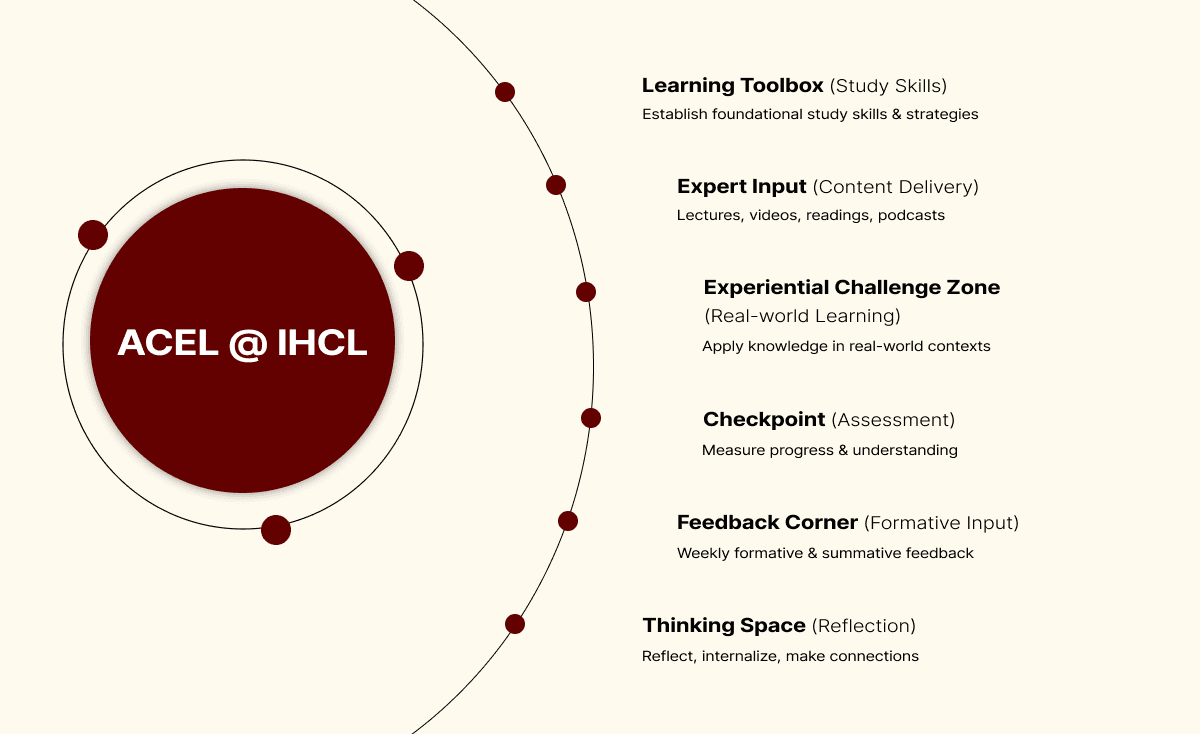
The ACEL Curve: Six Elements That Transform Learning
Every weekly unit in IHCL’s programmes follows the “ACEL Curve,” comprising six carefully designed elements that deepen learning through cumulative, scaffolded, and experiential engagement.
1. Learning Toolbox
We start by scaffolding foundational study and self-regulation skills. Not everyone arrives at higher education with the same academic toolkit, and that’s perfectly fine. Whether you’re returning to study after twenty years or you’ve never felt confident in traditional educational settings, we ensure you have the tools you need to succeed.
2. Expert Input
We deliver diverse, high-quality content in accessible formats. It’s about recognising that people learn differently. Some thrive with visual content, others with audio, some need to read, others to discuss. Many need a mixture with different modes. We provide multiple pathways to the same high-quality learning.
3. Experiential Challenge Zone
Here’s where theory meets practice. You apply learning in authentic, real-world, or simulated contexts. For working professionals, this often means immediate application to your current role. For career changers, it’s about building practical experience in your chosen field.
4. Checkpoint
Regular, low-stakes assessment tracks and celebrates progress. Instead of high-pressure exams that can disadvantage certain learners, we use frequent check-ins that help you understand where you are and where you’re going.
5. Feedback Corner
We foster feedback literacy and personal growth. This isn’t just about grades - it’s about developing the ability to give and receive feedback effectively, a crucial skill for any professional environment.
6. Thinking Space
We encourage reflection and emotional-cognitive integration. Learning isn’t just intellectual - it’s personal, emotional, and transformative. This space helps you make sense of your journey and integrate new knowledge with your existing experiences.
Rich Human Interaction: The Heart of Learning
To honour our commitment to human connection, this weekly structure is wrapped around meaningful touchpoints:
- Weekly Synchronous Webinars bring the energy of flipped-classroom learning with interactive breakout activities that work whether you’re joining from your kitchen table or the office.
- Bi-weekly 1:1 Coaching Sessions focus on your learning, wellbeing, and academic growth - because education is about more than merely academic achievement.
- Two-way Reflections create genuine dialogue between learners and tutors through shared journaling and response loops that build real relationships.
- Professional Mentoring connects your learning directly to career development through regular guest mentor sessions with industry professionals.
- Learning Circles foster peer learning in small pods with just enough structure to be supportive but enough autonomy to be empowering.
Six Principles That Change Everything
Our approach rests on six core principles designed for real people with real lives:
Inclusivity by Design - We don’t retrofit accessibility; we build it in from the ground up. Flexible, multi-modal, and welcoming to all neurotypes.
Confidence as Curriculum - Academic confidence isn’t assumed; it’s cultivated. Learners grow in academic identity and self-belief through structured, achievable wins.
Experiential Learning - Every lesson is anchored in real-world application, not abstract theory that feels disconnected from your goals.
Rhythmic Structure - Repetition and routine provide grounding for self-regulation and clarity - particularly valuable for neurodivergent learners and those juggling complex lives.
Interpersonal Anchoring - Real-time human interaction drives learning. Education is fundamentally social. We promote genuine human connection and won’t let technology replace that.
Growth-Oriented Feedback - Regular, compassionate feedback cultivates resilience and excellence, helping you see mistakes as learning opportunities rather than failures.
The Learning Curve That Transforms Lives
Think of ACEL as a learning curve that represents the journey our students take. You grow into a topic gradually, understanding what’s required while gaining the necessary skills to be a confident student. Then, with support, you transition out of your comfort zone and into the growth zone through experiential learning and diverse, modern assessment formats.
Finally, you gain clarity on your learning through expert feedback, working with academic coaches and personal mentors during an introspective period of self-exploration. Here, you contextualise your learning experience and make sense of what it means for your personal and professional future through focused reflection.
Structure That Sets You Free
Importantly, all key elements of a comprehensive learning experience happen every single week. This provides much-needed structure, so you always know what to expect and what comes next - perfect for those returning to education, managing complex schedules, or those who’ve never felt aligned with traditional rote learning methods.
By providing consistent structure, we actually create more freedom – a perfect paradox. When you know what to expect, you can plan around it. When learning is chunked into manageable pieces, you can fit it into your life rather than having to rebuild your life around education.
Education That Finally Fits
ACEL represents more than just a new teaching method - it’s a fundamental shift toward education that recognises the complexity and richness of modern learners’ lives. Whether you’re a working professional, a parent with caring responsibilities, someone from a non-traditional educational background, or a neurodiverse learner who thinks differently, this approach meets you where you are and helps you grow from there.
The question isn’t whether you have time for education - it’s whether education has been designed to work with your time, your learning approach, and your life goals. With ACEL, the answer is finally yes.
Ready to experience learning that works around your life, not against it? Take a look at our programmes to discover how our human-centred approach could transform your educational journey while you continue to manage everything else that matters to you.
3 September 2024